An Introduction to "Kozuyu," a Traditional Dish from Aizu | A Festive Soup Served with Scallop Broth and a Small Plate of Salt
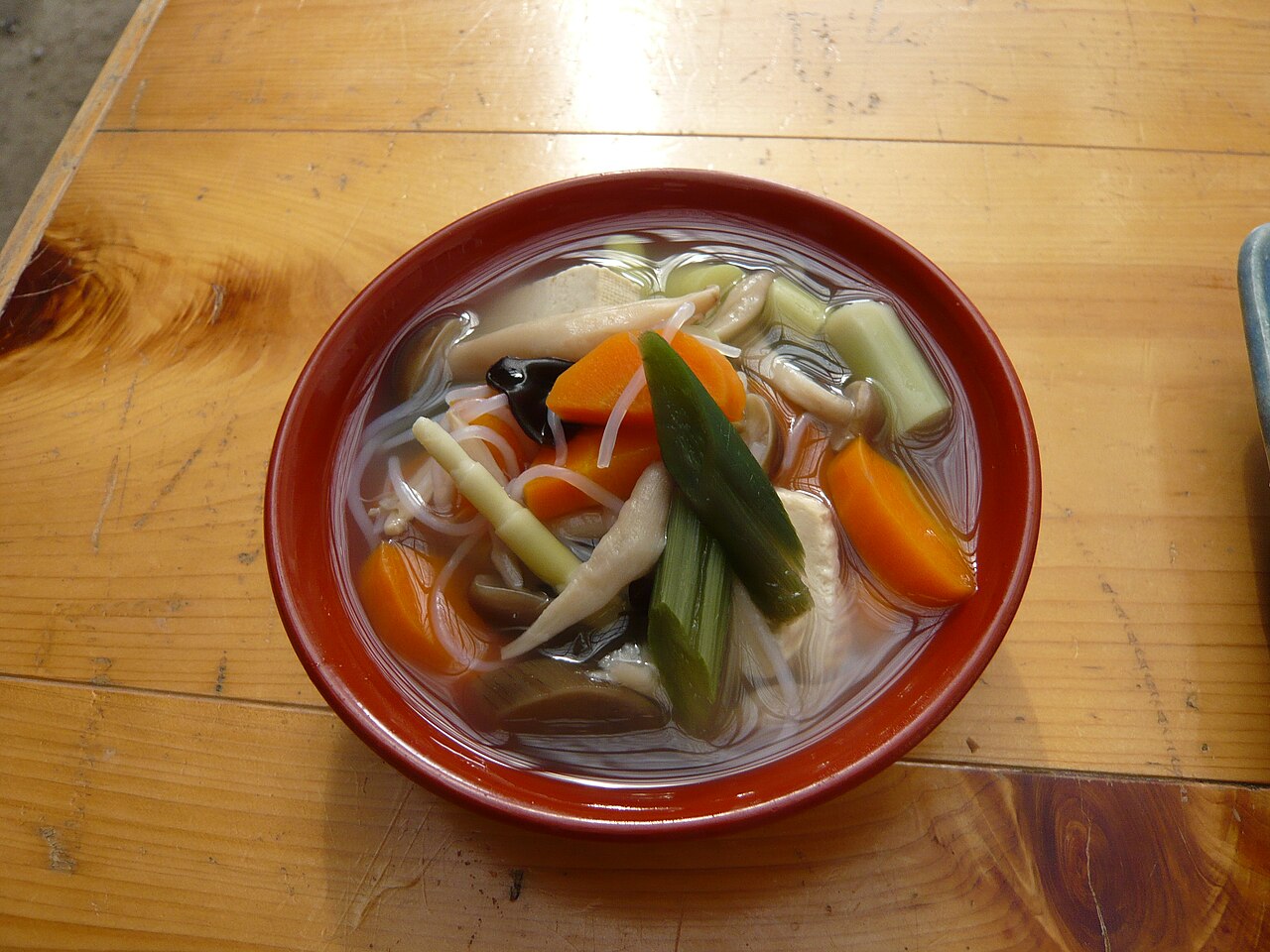
At celebratory banquets in Aizu-Wakamatsu, when the meal is served, a soup featuring a variety of colorful ingredients peeking out from a small, vermilion-lacquered bowl is served as a side dish. This is “Kozuyu,” a representative local dish of Aizu.The star of the dish is the broth made from dried scallops—a precious ingredient in landlocked Aizu. This lightly seasoned soup, combined with mountain delicacies such as taro and mushrooms, has been passed down as an essential dish for hospitality on “special occasions” such as weddings, funerals, and New Year’s.In this article, we’ll introduce the origins of Kozuyu, its ingredients, the proper way to serve it, and its connections to other local dishes—all based on official information—for those visiting Aizu for the first time.
What kind of dish is Kozuyu?
Kozuyu is a hearty soup made with broth from dried scallop adductor muscles (dried scallop adductor muscles), simmered with ingredients such as taro, carrots, wood ear mushrooms, dried shiitake mushrooms, shirataki noodles, and mamefu (soybean gluten).According to the Ministry of Agriculture, Forestry and Fisheries’ reference materials on regional cuisine, it is characterized by “a well-balanced blend of seafood, such as scallop adductor muscles, and mountain produce, such as bracken and taro.” The basic seasoning is a light blend of soy sauce and salt; this subtle flavor, which brings out the delicate aroma of the scallop adductor muscles, is the hallmark of Aizu-style Kozuyu.It is said that using an odd number of ingredients—either seven or nine—brings good luck.
Originally served as part of celebratory meals during the winter, it has now become an indispensable dish for entertaining on special occasions such as weddings, funerals, and New Year’s. In recognition of its history, it was designated in Reiwa 3 as one of the “Traditional 100-Year Foods—Regional Dishes Continuously Prepared Since the Edo Period” by the Agency for Cultural Affairs’ “100-Year Foods” initiative.
As for the origin of its name, it is said to be a corrupted form of “Kojū no Tsuyu” (according to Fukushima Prefecture Tourism Information). It is said that there was a time when it was served in two separate bowls, referred to as “Ichino-ju” and “Nino-ju,” or “Ichino-tsuyu” and “Nino-tsuyu.”
Its roots lie in the samurai cuisine of the Aizu Domain
Looking at the ingredients of Kozuyu, dried seafood—particularly scallop meat—stands out. Why did a dish featuring seafood as its main ingredient emerge in Aizu, an inland region surrounded by mountains?The key lies in the Kitamae ships that plied the Sea of Japan during the Edo period. Seafood caught in places like Hokkaido was processed into dried goods, transported by Kitamae ships to Niigata, and then carried further to Aizu via the Agano River waterway.Even in documents certified by the Agency for Cultural Affairs, Kozuyu is described as “a dish created through the combination of seafood brought primarily by Kitamae ships during the Edo period and Aizu’s traditional local produce.”
Regarding its origins, it is said to trace back to a dish called “Jū,” which Lord Matsudaira Katanoori, the eighth lord of the Aizu Domain, ate during his sankin-kōtai travels in the late Edo period.Documents from the Ministry of Agriculture, Forestry and Fisheries also describe Kozuyu as “originally a samurai dish,” and it is an indispensable part of the culinary culture of the castle town of Aizu-Wakamatsu.That said, there are various theories regarding its origins, including one that traces it back to shojin ryori (Buddhist vegetarian cuisine). It can be said that this dish evolved into its current form as it spread from the tables of the samurai class to merchant households and eventually became a feast for the common people.
In inland Aizu, where fresh seafood was difficult to obtain in an era before refrigeration and freezing technology, Kozuyu—which featured long-lasting dried ingredients as its main components—was the culmination of ingenuity unique to the region.
Standard Ingredients and Seasoning
While the ingredients in Kozuyu vary slightly depending on the household or restaurant, the typical lineup is as follows.
Category | Main Ingredients |
|---|---|
Main Ingredients for the Broth | Dried scallops (used along with the soaking liquid) |
Forest and Farm Produce | Taro, carrots, bracken, bamboo shoots, etc. |
Mushrooms | Dried shiitake mushrooms, wood ear mushrooms, shimeji mushrooms, etc. |
Other | Shirataki noodles, bean gluten, ginkgo nuts, etc. Seasonal Ingredients |
The key to making this dish is to soak the dried scallops thoroughly over time and use every drop of the soaking liquid as broth. Simmer the ingredients in the broth and season very lightly with soy sauce and salt.Another characteristic is cutting the ingredients into uniform, small pieces; it is said locally that the dish really comes together when made in large quantities in a big pot. The fact that cutting techniques and seasoning vary slightly from household to household is typical of regional cuisine.
The serving dish is an Aizu-nuri “Teshiozara”
When discussing Kozuyu, the serving dish is indispensable. Traditionally, Kozuyu is served in an Aizu-nuri bowl called an “Ohira,” and portions are divided onto small vermilion-lacquered plates known as “Teshiozara” (designated as part of the Agency for Cultural Affairs’ “100-Year Food” program).The “Teshio-zara,” also known as the “Kozuyu Bowl,” is a dish specifically designed for this dish. Unlike a round, deep bowl, it is characterized by its small, shallow, and flat shape, resembling a small plate. Fukushima Prefecture’s tourism information also describes it as “a shallow bowl made from Aizu-nuri lacquerware.”
The small size of the dish embodies a spirit of hospitality. It is said to express a humble sentiment: “We cannot offer a lavish meal, but please help yourself to as many servings of this as you like.” Consequently, even at formal celebratory gatherings, asking for a second helping of Kozuyu is not considered rude.Kozuyu served in a vermilion-lacquered Aizu-nuri bowl is not merely a soup; it is a dish that embodies the very spirit of Aizu hospitality.
Aizu’s Local Cuisine, Linked by Dried Seafood
The combination of “dried seafood from the Kitamae ships and ingredients from the mountainous region” that forms the basis of kozuyu is also found in other local dishes of Aizu.
Sancho-marinated Herring
This dish consists of dried herring (the flesh of the fish) layered with sansho leaves and marinated in soy sauce, vinegar, and sake. According to data from the Ministry of Agriculture, Forestry and Fisheries, it is commonly eaten in the Aizu-Wakamatsu area and has become so popular that there is even a dedicated container for marinating it called a “nishin-bachi.”Dried herring is also a seafood product brought from Hokkaido during the Edo period that served as a long-lasting source of protein. It is believed that sansho was paired with herring to mellow its distinctive odor and enhance its flavor. Prepared from spring, when the sansho buds begin to sprout, through early summer, it is also a seasonal delicacy.
Simmered “Bōtara”
This dish is made by slowly rehydrating cod dried until it is as hard as a stick (bōdara) in water and then simmering it for a long time.It is characterized by being simmered until even the bones are tender enough to eat, and with its sweet-and-salty seasoning, it has long been served at celebratory feasts and on family dining tables. This, too, is a preserved food born from the ingenuity of distributing cod—a fish that does not keep well—in dried form.
Kozuyu, herring pickled in sansho pepper, and simmered “bō-tara.” All three were born from an idea unique to inland castle towns: “combining dried seafood from distant seas with the bounty of the mountains to create delicious meals.” By focusing on this common thread, you can truly savor the history of the region.
Where to Find Kozuyu in Aizu
Kozuyu is often served at restaurants in Aizu-Wakamatsu that specialize in local cuisine, as well as during group meals and set meals at lodging facilities. For home cooking, “Kozuyu sets”—which include all the necessary ingredients—are sometimes sold at local supermarkets and souvenir shops.If you see the word “Kozuyu” while traveling, be sure to experience Aizu’s hospitality—including the tradition of sharing dishes and asking for seconds.
Information verified on: November 8, 2026
Reference Information
- Agency for Cultural Affairs “100-Year Foods” Fukushima Prefecture List (Kozuyu)
- Fukushima Prefecture: “On the Preservation of Fukushima’s Traditional Food Culture”
- Ministry of Agriculture, Forestry and Fisheries: “Our Local Cuisine” – Kozuyu
- Ministry of Agriculture, Forestry and Fisheries: “Our Local Cuisine” – Herring Pickled in Sansho Pepper
- Premium Aizu “Kozuyu”
Featured Image: Opqr “Kozuyu” Wikimedia Commons (CC BY-SA 3.0)
