Tsuruga Castle Guide | Japan’s Only Castle with a Red-Tiled Main Keep and a Castle from the Boshin War: Admission Fees, Recommended Visit Time, Fall Foliage, and Access
"Tsuruga Castle," with its red-tiled keep standing out against white walls, is the symbol of Aizuwakamatsu City in Fukushima Prefecture.Its official name is Wakamatsu Castle. Known as an “impregnable fortress” that withstood attacks for about a month during the Boshin War of 1868, the current castle tower was rebuilt in 1965 and, in 2011, became the only one in Japan to be re-roofed with red tiles.This article summarizes the highlights of the Castle Keep Museum, along with admission fees and opening hours; the combined ticket with the Rinkaku Tea House; the autumn foliage and projection mapping in November; and access information and estimated travel time.
About Tsuruga Castle | The Symbol of Aizu-Wakamatsu, the “Impregnable Castle”
Tsuruga Castle is a hirayama-style castle towering over the center of Aizu-Wakamatsu City. Its official name is Wakamatsu Castle; the castle ruins are designated as a National Historic Site and are counted among Japan’s 100 Most Famous Castles. Characterized by the contrast between its white walls and reddish-brown roof tiles, it is a landmark of Aizu visible from anywhere in the castle town.
The interior of the main keep is open to the public as the “Wakamatsu Castle Main Keep Local History Museum,” featuring exhibits on the history of Aizu, the Boshin War, and the Byakkotai. From the observation deck on the top floor, visitors can enjoy views of the Aizu-Wakamatsu cityscape, the Aizu Basin, and, on clear days, Mount Bandai.Within the castle ruins park, remnants such as the Rinkaku tea house, the stone walls of the main keep, and the “Hashiri-Nagaya” row houses remain, allowing visitors to experience Aizu’s history simply by strolling through the park.
The History of Tsuruga Castle | From Its Construction in 1384 Through the Boshin War to Its Reconstruction
The origins of Tsuruga Castle are traced back to Higashi-Kurokawa-kan, built in 1384 (the first year of the Chitoku era) by Ashina Naomori, the seventh head of the Ashina clan. At that time, it was known as Kurokawa Castle.
In 1592, Ujisato Gamō, who had taken control of Kurokawa Castle, began a major renovation of the castle. The following year, in 1593, a seven-story castle keep was completed, and the castle’s name was changed to “Tsuruga Castle.”The town’s name was also changed from Kurokawa to Wakamatsu, and the castle town was developed. Later, in 1639, Kato Akinari rebuilt the seven-story main keep into a five-story structure, establishing the prototype for the current main keep.
During the Boshin War of 1868, the Aizu Domain held out under siege for about a month despite fierce attacks by the new government forces, and the castle did not fall. This battle cemented its reputation as an “impregnable fortress.”In 1874 (Meiji 7), following the Meiji Restoration, the castle keep and other structures were dismantled under the Castle Abolition Order; however, in 1965 (Shōwa 40), the exterior was restored using reinforced concrete, and the interior was rebuilt as a local history museum.In 2011, the roof tiles were replaced from black to red, bringing the structure closer to its appearance during the Boshin War.
Highlights of the Castle Keep Museum | Aizu’s History and the Top-Floor Observation Deck
The interior of the castle tower houses a museum spanning the first through fifth floors, featuring exhibits on the history of the Aizu Domain, the Boshin War, the Byakkotai (White Tiger Corps), as well as armor and swords. The exhibits are arranged chronologically, with each floor covering a later period, allowing visitors to trace the history of Aizu as they tour the museum.
The top floor serves as an observation deck, offering a 360-degree panoramic view of Aizu-Wakamatsu. From the front of the castle tower, the streets of the castle town stretch out before you, while on the opposite side, you can see the Aizu Basin and Mount Bandai.Since visitors must climb stairs from the entrance to tour the castle keep, those with mobility issues are advised to allow plenty of time for their visit.
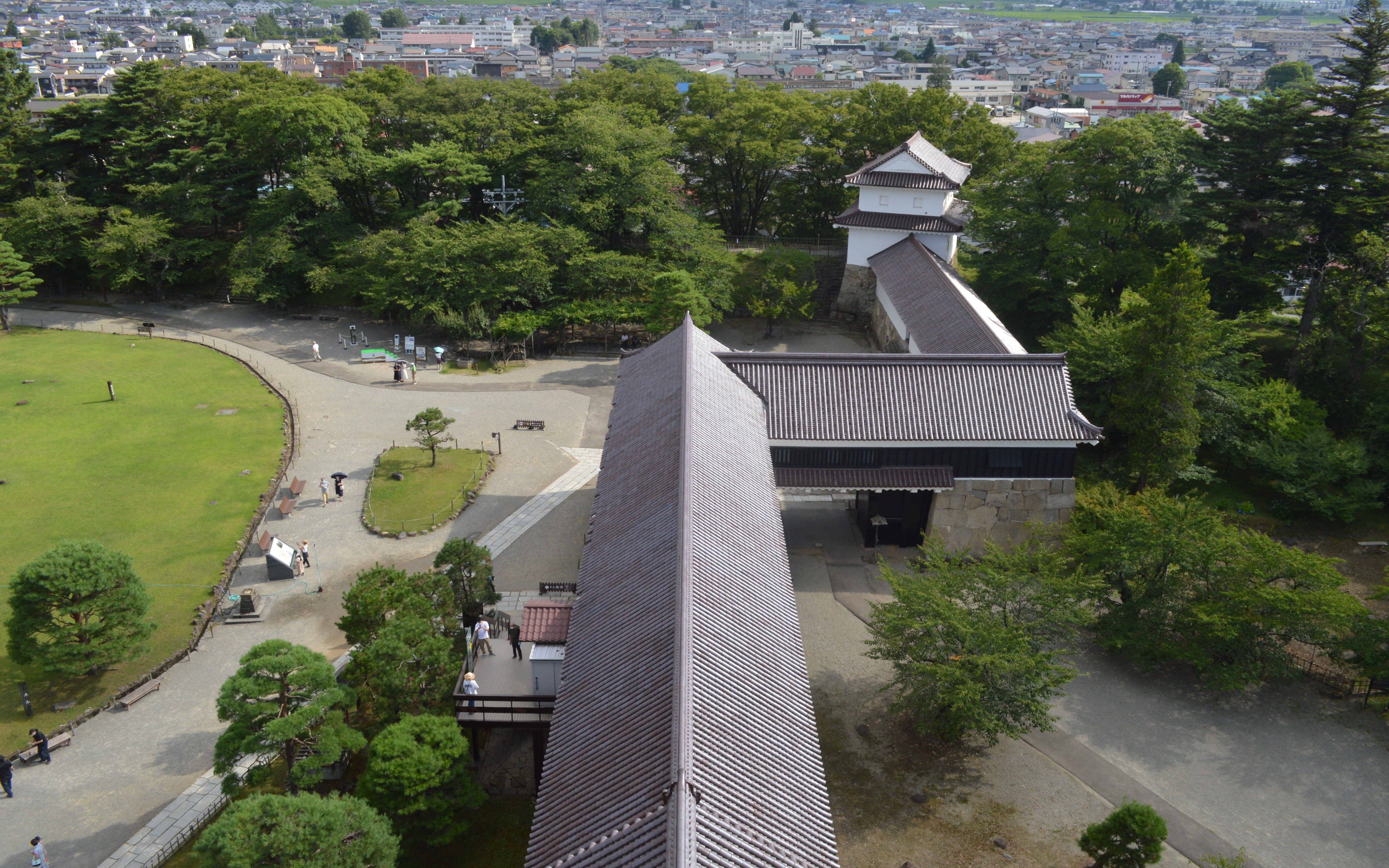
Around the main keep, the stone walls of the Honmaru, the iron gate, and the “hashiri-nagaya” (row of guard houses) are also highlights. In particular, the view of the stone walls from the Honmaru ruins conveys the castle’s former fortitude to this day.
Admission Fees and Hours
Item | Details |
|---|---|
Address | 1-1 Ote-machi, Aizuwakamatsu City, Fukushima Prefecture 965-0873 |
Phone | 0242-27-4005 (Tsurugajo Management Office) |
Castle Keep Hours | 8:30 a.m.–5:00 p.m. (Last admission at 4:30 p.m.) |
Closed | Open daily |
Admission Fees for the Main Keep | Adults: 410 yen; Elementary and Junior High School Students: 150 yen |
Combined Ticket for the Castle Keep and Rinkaku Tea House | Adults: 520 yen |
Combined Ticket for 3 Facilities (Castle Keep, Rinkaku, and Medicinal Herb Garden) | 730 yen |
Admission to the Rinkaku Tea House | Adults: 210 yen; Elementary and junior high school students: Free |
Notes | Free admission for holders of a disability certificate |
Prices are based on information from the official Tsurugajo Castle website (Aizu-Wakamatsu Tourism Bureau). Admission to the castle ruins park is free; admission fees apply only to the castle keep and the Rinkaku Tea House. Opening hours may be extended during events or peak seasons.
Combined Ticket for the Rinkaku Tea House | A Tea House Associated with Shōan, Son of Sen no Rikyū
The “Rinkaku” tea house, located within Tsuruga Castle Park, is said to have been built by Shōan, the son of Sen no Rikyū. After the Boshin War, it was preserved in the castle town and was relocated and restored to its current location in Heisei 2 (1990).Visitors can enjoy tea inside the tea house, and tea ceremonies are held regularly.
Admission to Rinkaku is 210 yen for adults; elementary and junior high school students are admitted free of charge. A tea ceremony costs 600 yen per session, though the price is scheduled to increase to 700 yen starting December 1, 2026.If you plan to visit both the castle keep and Rinkaku, the combined ticket for the castle keep and Rinkaku (520 yen for adults) is a great value. Furthermore, if you plan to extend your visit to the Imperial Medicinal Garden, a combined ticket for all three facilities (730 yen) is also available.
Tsuruga Castle in November | Peak Autumn Foliage Season and Projection Mapping 2026
The autumn foliage at Tsuruga Castle Park typically reaches its peak from late October to mid-November. This is a season when the maple, ginkgo, and zelkova trees within the park turn vibrant colors, creating a beautiful contrast with the castle’s white walls and red-tiled roof.As of November 13, 2026, the foliage is reported to be at its peak (70–80% colored), and the leaves are expected to begin falling around November 22. The autumn foliage illumination will take place from mid-October through mid-November.
For three days, from Friday, November 20, to Sunday, November 22, 2026, “Tsurugajo Projection Mapping 2026” will be held, featuring the castle keep and stone walls as its backdrop.The visuals, featuring motifs such as Aizu lacquerware, Aizu painted candles, and Aizu cotton, will include a “sea of clouds” effect for the first time.The event runs from 5:30 PM to 9:00 PM; admission is free, and no advance registration is required. The approximately 8-minute program will be projected continuously with a roughly 3-minute intermission. For more details, please visit the official website for Tsuruga Castle Projection Mapping 2026.
Access and Estimated Travel Time
Item | Details |
|---|---|
Train/Bus | From JR Aizu-Wakamatsu Station, take the “Haikara-san” downtown loop bus to “Tsurugajo Entrance” (approx. 21 minutes), then walk for about 5 minutes |
On Foot | About a 30-minute walk (approx. 2.8 km) from Aizu-Wakamatsu Station |
By Car | Take the Ban-Etsu Expressway to the Aizu-Wakamatsu Interchange, then head toward the city center. The nearest parking lot is the Nishidemaru Parking Lot |
Estimated Time | Approx. 45–60 minutes for the castle keep interior only; approx. 90–120 minutes including a stroll through the park and Rinkaku |
The “Haikara-san” downtown sightseeing bus connects Aizu-Wakamatsu Station with Tsuruga Castle, Nanokamachi Street, and other attractions. If you plan to visit Tsuruga Castle and Nanokamachi Street on the same day, using the Haikara-san bus will make your travel much smoother.
Spots to Visit Along with Tsuruga Castle
To the east of Tsuruga Castle, about a 15-minute walk away, lies “Oyaku-en,” a daimyo garden associated with the Aizu Matsudaira clan. It is a strolling garden featuring a “Heart-Shaped Pond,” and during the fall foliage season, the reflection of the colorful leaves on the pond is a highlight. For more details, please see the Oyaku-en Guide.
On Mt. Iimori, about a 10-minute drive from Tsuruga Castle, you’ll find the graves of the 19 members of the Byakkotai and the double-helix Sazaedo. Visiting these sites alongside Tsuruga Castle will give you a deeper understanding of the history of the Boshin War. For more details, please see the Aizu Sazaedo (Ento Sansodo) and Mt. Iimori guide.
For those interested in the history of the castle town, we also recommend the Aizu Samurai Residences located north of Tsuruga Castle. This area features a collection of Important Cultural Properties, including the Saigo Yorimoto Residence, offering a glimpse into daily life in a samurai residence during the Edo period.
Summary
Tsuruga Castle is a renowned castle representing Aizu-Wakamatsu. Built in 1384, it underwent renovations by Ujisato Gamō and withstood a siege during the Boshin War. It took on its current form following its reconstruction in 1965 and the replacement of its roof tiles with red ones in 2011.At the Castle Keep Museum, you can learn about the history of Aizu, and from the top floor, you can enjoy views of the city and Mount Bandai. November is the peak season for autumn foliage, and with a projection mapping event taking place from November 20 to 22, you can enjoy a combination of a daytime tour of the castle keep and the nighttime projection show.When visiting Aizu-Wakamatsu, why not start your journey at Tsuruga Castle?
Information verified on: November 16, 2026 (Admission fees, opening hours, and event schedules are subject to change. Please check the official website for the latest information before your visit.)
*Photo: Tsuruga Castle Keep (“Aizuwakamatsu Castle ac (2),” Photo by Asturio Cantabrio, CC BY-SA 4.0, Wikimedia Commons)
