Ouchi-juku Tourist Guide | Highlights of the Thatched-Roof Post Town, Leek Soba, Access, and Parking
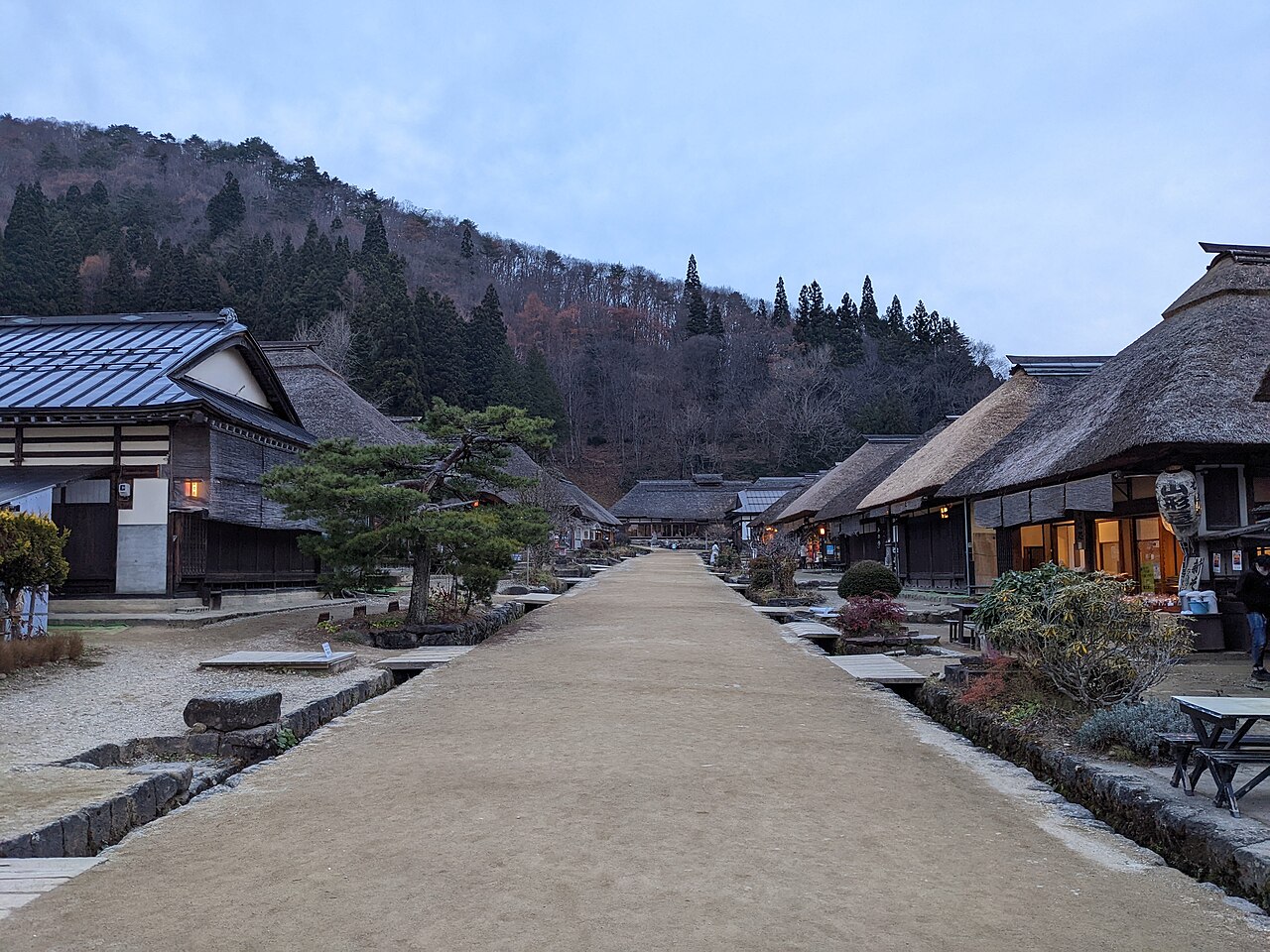
Located in a mountainous basin in Shimogo Town, Minamiaizu District, Fukushima Prefecture, Ouchi-juku is a village that still retains the appearance of an Edo-period post town.The sight of thatched-roof houses neatly lined up on both sides of the approximately 450-meter-long main street makes it feel as if you’ve stepped back in time to the Edo period.As a “living post town” where residents still live and run businesses, it attracts many tourists. This article provides an overview of the town’s history, must-see sights, the famous negi soba, and information on how to get there and where to park—all tailored for first-time visitors to Ouchi-juku.
The History of Ouchi-juku and Preservation of the Townscape
A “Half-Farming, Half-Inns” Post Town Connecting Aizu and Nikko
Ōuchi-juku was established in the early Edo period as a post town along the Aizu Nishi Kaidō (Shimotsuke Kaidō), which connected the castle town of Aizu-Wakamatsu with Shimotsuke Imaichi (present-day Nikko City, Tochigi Prefecture).It was fully developed by Masayuki Hoshina, the founder of the Aizu Domain, and featured a honjin (main inn) and a waki-honjin (auxiliary inn) where the domain lord would stay. The town is said to have bustled with processions for the sankin-kotai (alternate attendance) system and as a hub for the distribution of rice shipped from Aizu to Edo.Another distinctive feature of this town is that it was a “half-farming, half-post station” where residents combined work at the post station with farming.
In the Meiji era, the highway was rerouted to follow the Okawa River, and eventually, a railway line opened. While Ōuchi-juku ceased to serve as a key transportation hub, it was consequently left behind by the wave of modernization, resulting in the preservation of its Edo-period townscape.
Nationally Designated Important Preservation District for Groups of Traditional Buildings
On April 18, 1981 (Showa 56), an area of approximately 11.3 hectares—comprising the former post town district and the vicinity of Takakura Shrine—was designated as a National Important Preservation District for Groups of Traditional Buildings.Residents adhere to the three principles of their Residents’ Charter—“Do not sell, do not rent out, and do not demolish”—and continue to preserve the townscape while living in their homes, which also serve as shops. A portion of the fees collected from the tourist parking lot is allocated toward preserving this townscape and repairing rooftops.
Highlights
A Townscape of Thatched-Roof Houses
The main attraction is the scenery of the main street itself. Along both sides of the approximately 450-meter-long thoroughfare, more than 30 thatched-roof private homes—built in the hip-and-gable style with their gables (the shorter sides of the buildings) facing the street—stand in nearly equal intervals.Many of the houses are currently in operation as soba restaurants, eateries, souvenir shops, and guesthouses. The street has been restored to its original dirt-road surface, and utility poles have been moved to side streets so that nothing obstructs the view. Water flows abundantly in the irrigation canals on both sides, and you can still see the traditional sight of vegetables and drinks being cooled in the water. Strolling through the village itself is free of charge.
Koyasu Kannon and the Observation Deck
If you continue down the highway and climb the stone steps at the end, you’ll find the Koyasu Kannon Hall. From the observation deck (viewing area) nearby, you can take in a panoramic view of the highway stretching straight ahead and the row of thatched-roof houses—making it one of Ōuchi-juku’s most iconic photo spots.The stone steps are somewhat steep, so please climb slowly while watching your step.
Takakura Shrine
Takakura Shrine, situated at the edge of the village amidst a grove of cedar trees, is associated with a legend that Prince Mochihito of Takakura, who was exiled from the capital at the end of the Heian period, fled to this area. The area surrounding this shrine is also included in the preserved district.Every year on July 2—the day of Hange-shō—the shrine holds the “Hange Festival,” during which a procession winds its way through the village.
Site of the Former Honjin and Ōuchi-juku Townscape Exhibition Hall
Halfway along the highway stands the Ōuchi-juku Townscape Exhibition Hall (Shimogo Town Townscape Exhibition Hall), a reconstruction of the honjin (main inn) built on the site of the original honjin.Inside the museum, photographs from the past and everyday household items used by the post town’s residents are on display. Visitors can gain a concrete understanding of life in the post town by viewing the interior with its irori hearth and examining the structure of the thatched roof. Admission is 250 yen for adults and 150 yen for elementary and junior high school students.
Local Specialty: Leek Soba (Takato Soba)
The specialty of Ōuchi-juku is negi soba, which is eaten using a long green onion in place of chopsticks. This is the Ōuchi-juku style of eating “Takato soba,” a local soba dish from Aizu, where a whole long green onion is served alongside the soba.
The key to eating it is to scoop up the soba using the curved base of the green onion. You can also nibble on the green onion itself as a garnish. It’s commonly eaten with a dipping sauce that includes grated spicy daikon radish. This eating style is said to have originated at a soba restaurant in Ouchi-juku, where it gained popularity and spread throughout the entire post town.Most restaurants also provide regular chopsticks, so first-time visitors need not worry. Since the eating method varies slightly from restaurant to restaurant, please follow the staff’s instructions and enjoy your meal. Other well-known local dishes include “Shingorō,” a type of mochi coated with perilla miso and grilled over charcoal.
Access & Parking
Category | Details |
|---|---|
Location | Ouchi, Shimogo Town, Minamiaizu District, Fukushima Prefecture |
Train & Bus | Take the “Saruyu-go” shared bus from Yunokami Onsen Station on the Aizu Railway for about 20 minutes; get off at “Ouchi-juku Iriguchi” and it’s right there |
Saruyugo Fare | 1-Day Unlimited Ride Pass: Adults 1,100 yen, Children 500 yen (valid for 2 days). Priority is given to passengers who reserve by 7:00 PM the day before |
From Aizu-Wakamatsu | About 40 minutes by Aizu Railway to Yunokami Onsen Station |
By Car | Approx. 35 km from the Aizu-Wakamatsu Interchange on the Ban-Etsu Expressway via National Route 118 / Approx. 50 km from the Shirakawa Interchange on the Tohoku Expressway via National Routes 289 and 121 |
Parking | Paid parking lots (Parking Lots 1–3 and Temporary Parking Lot) are located near the entrance to the village. Payment is in cash on the day of use; reservations are not accepted (first-come, first-served). Please check the Ouchi-juku official website for rates. Vehicle access within the village is restricted |
Walking Tour | Free (Admission fee required for the Townscape Exhibition Hall) |
Inquiries | Ouchi-juku Tourism Association TEL 0241-68-3611 |
Information verified on November 8, 2026. The operating period, schedule, and fares for the “Saruyu” may be subject to change. Please check the Ouchi-juku Tourism Association’s official website for the latest information.Additionally, Aizu Railway offers the “Ouchi-juku Combined Discount Ticket” (Adults: 2,200 yen; Children: 1,100 yen), which combines a pass for the Aizu Line with a 2-day unlimited ride pass for the Saruyu.
Travel Tips
- Store Hours: Most shops are generally open from around 9:00 AM to 4:00 PM, though operating days and hours vary by store. If you plan to eat there, we recommend planning your visit to avoid the lunch rush.
- About Crowds: During long weekends, the fall foliage season, and the February Snow Festival, surrounding roads and parking lots tend to get crowded. Try to arrive in the morning. The Tourism Association recommends using the “Ōuchi-juku Kobushi Line” (Prefectural Route 131, Shimogo-Aizu-Hongō Line) when coming from the direction of Aizu-Misato Town.
- Check Return Bus Times in Advance: The “Saruyu” bus runs on a limited schedule. It’s a good idea to check the departure times for your return trip as soon as you arrive.
- Visiting in Winter: Ouchi-juku is located in an area prone to heavy snowfall. In winter, be cautious of icy roads and snow accumulation, and be sure to wear warm clothing and non-slip shoes. The “Ouchi-juku Snow Festival,” featuring rows of snow lanterns, is held every February.
- Etiquette for Strolling: Ōuchi-juku is a living community. Since thatched roofs are highly flammable, please exercise caution when handling fire within the village and smoke only in designated areas. Please refrain from entering the grounds of private homes.
Featured Image: Bernie Ongewe, “Ōuchi-juku” (Wikimedia Commons) / CC BY-SA 4.0
