Aizu Soba Guide | A Soba Journey in Aizu-Wakamatsu to Savor Takato Soba, Negi Soba, and 100% Buckwheat Soba
As you walk through the castle town of Aizu-Wakamatsu, you’ll see signs for soba restaurants everywhere. The climate of this basin, with its extreme temperature fluctuations, and the pure water flowing down from the mountains—it is this unique Aizu environment that has nurtured Aizu soba.Among the most famous varieties are “Takato Soba”—said to have been brought from Shinshu by the feudal lord Hoshina Masayuki—and “Negi Soba,” a specialty of Ouchi-juku.Also, “Juwari Soba”—made exclusively from buckwheat flour and boasting a rich aroma—is a must-try dish when visiting Aizu. At this time of year, when the fragrance of the autumn’s new buckwheat still lingers, enjoying a bowl of warm soba as Aizu heads into winter is a truly special experience. Why not set out on a journey to discover Aizu’s soba?
The Story of “Takato Soba”: A Flavor Brought by the Feudal Lord
The story of Aizu soba dates back to the early Edo period. Masayuki Hoshina, who became the first feudal lord of the Aizu Domain, spent his childhood in the Takato Domain of Shinano (present-day Takato Town, Ina City, Nagano Prefecture).It is said that when Masayuki entered Aizu, he brought soba-making artisans with him. This soba came to be known as “Takato Soba,” named after the founder of the domain’s hometown.
The most distinctive feature of Takato Soba is the flavor of its dipping sauce. In the early Edo period, it was common to eat soba with a broth made from grated spicy daikon radish and roasted miso. This method of eating soba—which predates the widespread use of soy sauce and bonito flakes—can be considered the origin of soba cuisine.“Karatsuyu”—a broth made by dissolving roasted miso in the juice squeezed from daikon radish—complements the flavor of the soba with its slight spiciness and the toasty aroma of the miso.
Over the years in Aizu, the practice of eating soba with soy sauce and bonito flakes has become widespread, but the traditional Takato soba style still survives today.Depending on the restaurant, some add miso and green onions to the daikon juice, while others let you enjoy the spiciness and sweetness of the daikon juice on its own—so even though it’s all called “Takato Soba,” the flavors vary widely. Comparing these different versions is one of the joys of enjoying Aizu soba.
Green Onions as Chopsticks! “Negisoba” in Ouchi-juku
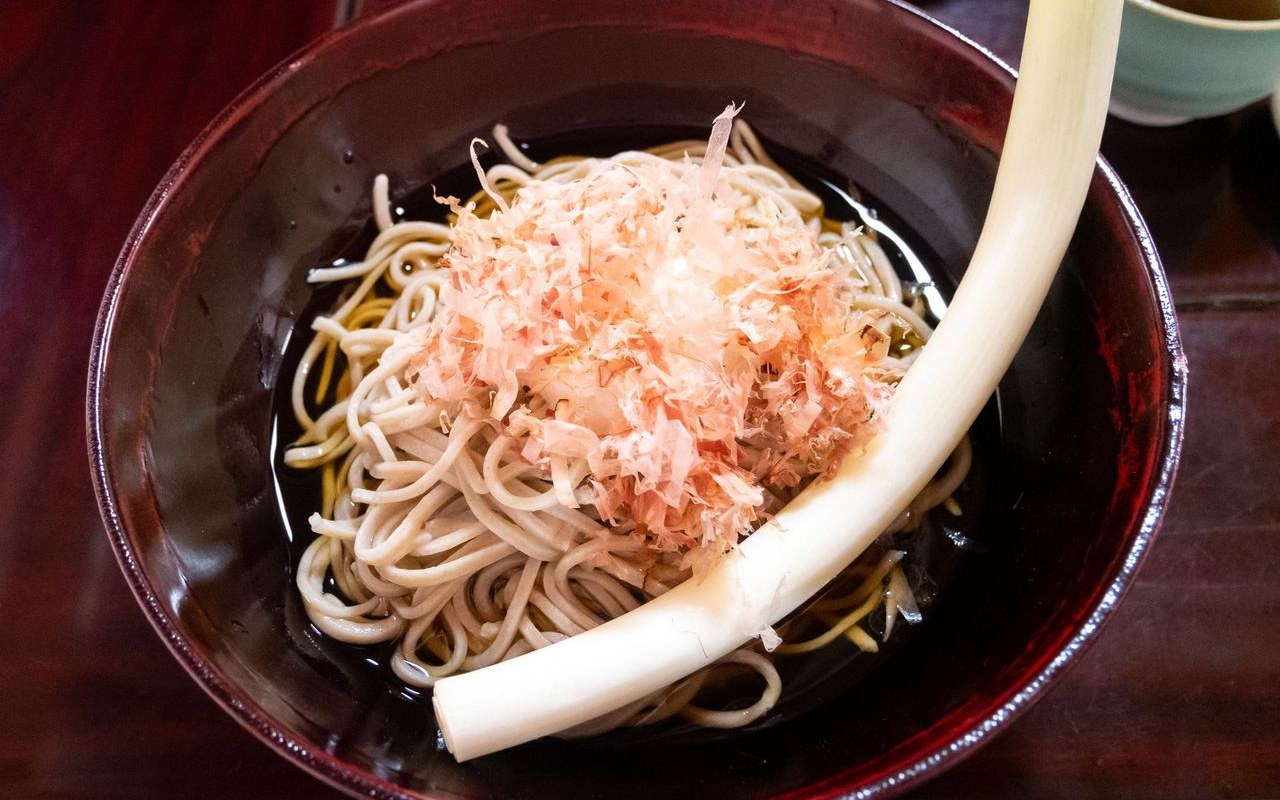
The most unique way to enjoy Takato Soba is at “Negi Soba” in Ouchi-juku.The firm, hand-made soba noodles are soaked in cold broth and topped with plenty of grated daikon and bonito flakes. Served alongside them is—believe it or not—a whole long green onion. You use this onion instead of chopsticks to scoop up the soba, occasionally taking a bite of the onion itself as a garnish.
This style of using a green onion as chopsticks is said to have been devised by soba restaurants in Ouchi-juku and has now spread throughout the entire post town.Known as the “original home of soba eaten with green onions” is the long-established shop “Misawaya,” located along the old highway. Enjoying negi soba in a tatami-mat room with an irori hearth inside the thatched-roof building is an experience unique to Ouchi-juku.At “Yamagataya,” also located along the highway, this dish is served under the name “Kaido Oroshi Soba,” and the featured photo is of a bowl from Yamagataya.
The trick to eating it is to use the curved base of the green onion like a hook to scoop up the soba. It might seem a bit confusing at first, but since the soba sits perfectly on the curved part, it’s actually easier to eat than you might think. You don’t have to force yourself to finish the entire green onion; the traditional way to enjoy it is to nibble on it little by little as a garnish.Also, since most restaurants provide regular chopsticks as well, first-time visitors can rest assured.
For information on Ouchi-juku’s highlights and how to get there, please also check out the Ouchi-juku Tourist Guide. In winter, Ouchi-juku is one of Japan’s heaviest snowfall areas. If you’re visiting by car, please make sure to equip your vehicle with winter gear, such as studless tires.
“Juwari Soba”: Savoring the Pure Aroma
“Juwari Soba,” made exclusively from buckwheat flour, is another major attraction of Aizu soba. Since no binding agents are used, the natural aroma and sweetness of the buckwheat come through directly.In Aizu-Wakamatsu City, you can enjoy it at places like the “Juwari Soba Association Aizu Main Store” (3-34 Sengoku-cho, Aizu-Wakamatsu City), located along the prefectural highway. Please check the official website of the Juwari Soba Association for more details.
When eating Juwari Soba, we recommend taking your first bite without any dipping sauce. After savoring the aroma and natural sweetness of the soba, dip it in the tsuyu sauce. At soba restaurants in Aizu, you can enjoy not only zaru soba but also hot kake soba and kenchin soba. During the colder months, be sure to try the hot soba to warm your body.
Aizu is also home to “Tachisoba,” a type of soba cut into thicker strands. Said to be named after the way the noodles are cut—much like cutting fabric—it’s characterized by a chewy texture. Since the cutting style and thickness vary by restaurant, comparing them is part of the fun.
To Enjoy Aizu Soba Even More
Aizu soba isn’t limited to the city center of Aizu-Wakamatsu; renowned restaurants are scattered throughout Minami-Aizu and the Inawashiro area as well. You can even enjoy a “Aizu Soba Road” tour, visiting hot springs and scenic spots while making your way from one soba restaurant to the next.Whether for lunch after strolling around Tsuruga Castle or Nanokamachi Street, or along the way to Higashiyama Onsen or Ashinomaki Onsen, why not incorporate soba into your travel itinerary?
Dried soba noodles also make excellent souvenirs. Dried noodles made with Aizu buckwheat flour can be found at souvenir shops along Nanokamachi Street and elsewhere. When cooking them at home, try serving them with a sauce made from grated spicy daikon radish—it’s a fun way to enjoy them in the style of Takato soba.
Aizu’s local sake is a perfect accompaniment to soba. You can learn more about Aizu’s sake in the Aizu Local Sake Guide. Visiting a sake brewery after a soba meal or comparing different sakes at an izakaya in the evening are among the highlights of a culinary journey through Aizu.
Practical Information for Your Soba Tour
Topic | Details |
|---|---|
Soba Restaurants in the City Center | Scattered around Aizu-Wakamatsu Station and Nanokamachi Street. “Juwari Soba Kai Aizu Main Store” is located at 3-34 Sengoku-cho, Aizu-Wakamatsu City |
Soba Restaurants in Ouchi-juku | Soba restaurants line the main street in Ouchi-Yamamoto, Shimogo Town (e.g., “Misawaya,” “Yamagataya,” etc.) |
Getting Around the City Center | The downtown sightseeing buses “Haikara-san” and “Akabee” run in loops toward Tsuruga Castle, Nanokamachi, and Mt. Iimori |
Access to Ouchi-juku | Drive from downtown Aizu-Wakamatsu toward Minami-Aizu. For details, please refer to the Ouchi-juku Tourist Guide |
Prices and Hours | Vary by store, so please check each store’s official information |
Summary
Aizu soba is a culinary tradition steeped in history—brought to the region by the feudal lord—and the wisdom of a snow-covered land. There’s “Takato Soba,” made with daikon radish juice and roasted miso; “Negi Soba” from Ouchi-juku, where green onions serve as chopsticks; and “Juwari Soba,” which lets you savor the pure aroma of the buckwheat.Once you learn these three ways to enjoy it, your Aizu soba journey will become much more meaningful. On your next trip to Aizu, be sure to savor a bowl of soba while strolling through the castle town.
Source & Reference Information
Date of Verification: November 23, 2026
Source:
- Wikipedia “Takato Soba” http://ja.wikipedia.org/wiki/高遠そば — Regarding the characteristics and history of Takato soba (Masayuki Hoshina, spicy radish broth, and Ouchi-juku’s negi soba)
- Nikkei Shimbun: “Tasting ‘Takato,’ the Birthplace of Soba: Spicy Daikon, Miso, and Green Onion Chopsticks” https://www.nikkei.com/article/DGXZZO15446620Y7A410C1000000/ — How to Eat Takato Soba: Differences Between Aizu and Shinshu
- Aizu-Wakamatsu Tourism Navigator: “Your First Visit to Aizu-Wakamatsu” https://www.aizukanko.com/feature/hajimete — The Status of Aizu Soba and the Downtown Sightseeing Bus
- Juwari Soba Association Official Website https://10wari-sobakai.jp/ — Location of the Aizu Main Store
- Mapple Web “Ouchi-juku, Yunokami Onsen, Ashino-maki Onsen” https://www.mapple.net/region/a0202110300/spot/?page=1 — Introduction to Misawaya in Ouchi-juku
- Mapple Web “Must-Try in Fukushima Prefecture! Recommended Popular Soba Spots” https://www.mapple.net/pref/07_g03050d00/spot/ — About Yamagataya’s Kaido Oroshi Soba in Ouchi-juku
Business hours, prices, and transportation information are subject to change. Please check the official website for the latest information before visiting.
Image Credit: Featured Image “Kaido Oroshi Soba (Green Onion Soba) (Yamagataya, Ouchi-juku)”— Wikimedia Commons, CC BY 4.0, Photo by Kurofune (File:Kaido Oroshi Soba (Negisoba) (Yamagataya, Ouchi-juku) 20201031-P1130114.jpg, taken October 31, 2020).
