Guide to Aizu Sazaedo (Ento Sanzaido) and Mt. Iimori | Exploring the Double Helix That Never Crosses and the Graves of the Nineteen Members of the Byakkotai
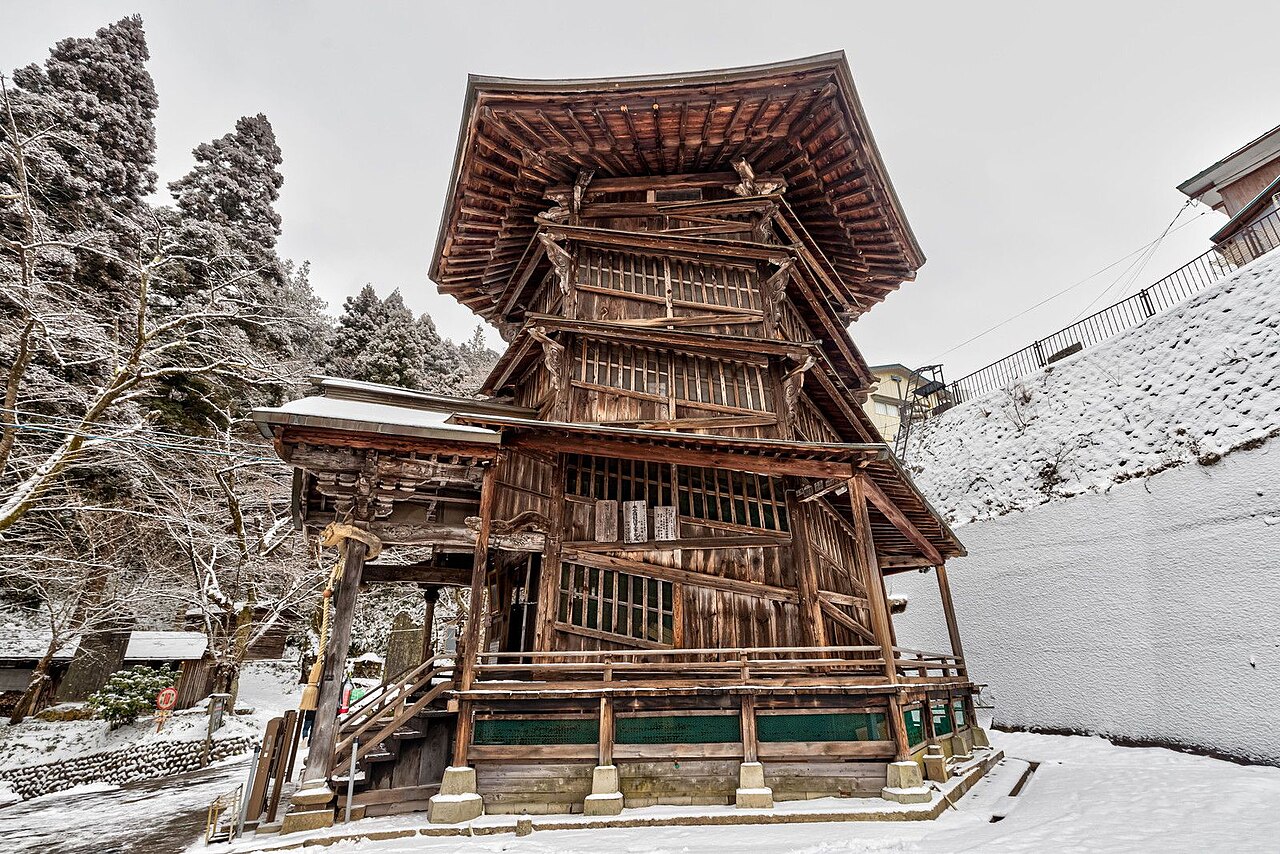
On the eastern side of Aizu-Wakamatsu City, halfway up the small Mount Iimori—which stands at an elevation of 314 meters—stands a mysterious wooden hall that appears to be slightly tilted.Officially known as Entsū Sansōdō but commonly referred to as “Aizu Sazae-dō,” this building is world-renowned for its double-helix structure, in which the ascending and descending pathways are completely separate, and it has been designated as an Important Cultural Property of Japan.In this article, we’ll provide a comprehensive overview of the Sazae-dō’s design and history, the highlights of Mount Iimori—including the graves of the 19 members of the Byakkotai—as well as visiting hours, admission fees, and access information. We hope this will help you plan your first visit to Aizu-Wakamatsu.
The Structure and History of Sazae-dō
A Double-Helix Ramp Where Visitors Never Cross Paths
Sazaedo is a three-story wooden structure approximately 16.5 meters tall with a hexagonal floor plan. Instead of stairs, a gentle, sloping corridor winds its way around the interior.This corridor is designed as a double helix, ensuring that the path leading up from the entrance to the top and the path descending from the top never intersect. Since visitors travel in one direction only—either ascending or descending—they never cross paths inside the hall. Wooden structures that allow visitors to ascend and descend all three stories using only ramps, without any stairs, are considered extremely rare worldwide.
The architect was Ikudo, the head priest of Shōshū-ji Temple
The hall was built in the 8th year of the Kansei era (1796) during the Edo period. It is said to have been designed by Ikudo, the head priest of Shōshū-ji Temple, which stood on this site at the time. While Shōshū-ji Temple itself no longer exists, only this Sansō-dō, situated halfway up the mountain, preserves its original appearance.“Sansō” means “to circle three times.” Originally, statues of Kannon from the Saigoku Thirty-Three Kannon Pilgrimage were enshrined inside the hall along a slope; it is said that the intention was for worshippers to gain the same merit as making a pilgrimage to the thirty-three distant sacred sites by circling this area three times.Although the Kannon statues were moved to another location during the Meiji period, the building itself was recognized for its architectural and historical value and was designated a National Important Cultural Property in 1995 (Heisei 7). It is also a constituent cultural property of the Japan Heritage site “Aizu’s Thirty-Three Kannon Pilgrimage.”
Highlights Inside the Hall
When viewed from the side, the entire building appears distorted, and its resemblance to a turban shell (sazae) is the origin of its common name. At the entrance, a wooden statue of Ikudo, the building’s designer, welcomes visitors.
Inside the hall, highlights include the double-helix ramp itself, as well as the senja-fuda (votive tablets) affixed to the beams and walls near the top. These tablets, left by visitors from all over the country as proof of their pilgrimage, have accumulated over the years to form multiple layers.Furthermore, at the summit, where the ascending and descending ramps switch places, a small arched bridge spans the gap, allowing visitors to experience the strange sensation of “suddenly finding themselves on the descending path” as they walk.
Highlights of the Mt. Iimori Area
The Graves of the Nineteen Members of the Byakkotai and the Site of Their Seppuku
Mount Iimori also served as a stage for the Boshin War (1868) during the Bakumatsu period. Among the Byakkotai—a unit composed of young men from the Aizu Domain—20 members of the Second Squadron retreated from the Battle of Tonoguchi-hara and reached this mountain.Seeing the castle town ablaze, the soldiers mistakenly believed the castle had fallen; they took their own lives here, with only one surviving to later recount the events of that time.The graves of the 19 members of the Byakkotai honor the 19 who lost their lives. Even today, the smoke from incense sticks never ceases to rise from the graves, and visitors can be seen quietly bowing their heads in prayer. From the hilltop where the graves are located, you can overlook the city of Aizu-Wakamatsu and the mountain ranges surrounding the Aizu Basin.
183 Stone Steps and the “Moving Slope” Conveyor
A flight of 183 stone steps leads from the entrance of the approach path at the foot of the mountain to the gravesite. Alongside the stone steps is the Iimoriyama Slope Conveyor (commonly known as the “Moving Slope”), which operates on a fee basis and is available for uphill travel only.This covered, escalator-style ride is a great help for those who aren’t confident in their leg strength, families with small children, and on hot or snowy days. The standard route for the descent is to walk back down the sloped path, which also passes by the Byakkotai Memorial Museum.
Visitor Notes
Item | Details |
|---|---|
Name | Ento Sanza-do (Aizu Sazae-do) |
Location | 1404 Hachiman Benten-dō, Ichimi-chō, Aizuwakamatsu City, Fukushima Prefecture (mid-slope of Mt. Iimori) |
Visiting Hours | April–November: 8:15 a.m. to sunset / December–March: 9:00 a.m. to 4:00 p.m. |
Admission Fees | Adults: 400 yen / College and High School Students: 300 yen / Elementary and Middle School Students: 200 yen |
Closed | Open year-round |
Slope Conveyor | Available for uphill travel only. Adults: 250 yen; Children: 150 yen. Operating hours are 8:00 a.m. to 5:00 p.m. from March 21 to November 20, and 9:00 a.m. to 4:00 p.m. from November 21 to March 20 |
Access (Bus) | From JR Aizu-Wakamatsu Station, take the downtown loop bus “Haikara-san” or “Akabee” and get off at the “Iimori-yama-shita” bus stop; it’s about a 5-minute walk from there |
Access (by Car) | Approximately 15 minutes from the Aizu-Wakamatsu Interchange on the Ban-Etsu Expressway. A city-operated parking lot is available at the foot of the mountain. |
Information verified on November 8, 2026. The slope conveyor may be suspended due to weather conditions or other factors. Please check the official Aizu Sazaedo website for the latest information.
Travel Notes
- Estimated time required: About 15 minutes if you’re only visiting the interior of Sazaedo. If you plan to tour the entire Mt. Iimori area, including the graves of the 19 members of the Byakkotai and the site of their ritual suicide, it’s best to allow 60 to 90 minutes.
- Footwear: The approach consists of 183 stone steps. Please wear comfortable walking shoes. In winter, snow and ice can make the path slippery, so please be especially careful.
- Note on Shortened Winter Hours: From December through March, both the viewing hours and the operation of the inclined conveyor end earlier than usual. It’s best to plan your visit from the morning through early afternoon.
- Combine with Tsuruga Castle: Mt. Iimori is just a few minutes away from Aizu-Wakamatsu Station by sightseeing bus. It’s an area that’s easy to combine with sightseeing in the Tsuruga Castle area on the same day.
- The winter scenery is also a highlight: Aizu-Wakamatsu receives heavy snowfall in winter, making this the perfect time to see Sazaedo Temple covered in a blanket of white snow. However, the approach path and the area around the temple can become slippery, so we recommend dressing warmly and wearing non-slip shoes.
Featured Image: Photographed by Kurofune (User:Jranar), “Aizu Sazaedo (Ento Sanzaido)” / CC BY 4.0 (Wikimedia Commons)