Oyakuen Guide | The History, Highlights, and Admission Information for the Daimyo Garden Associated with the Aizu Matsudaira Clan and Its Medicinal Herbs
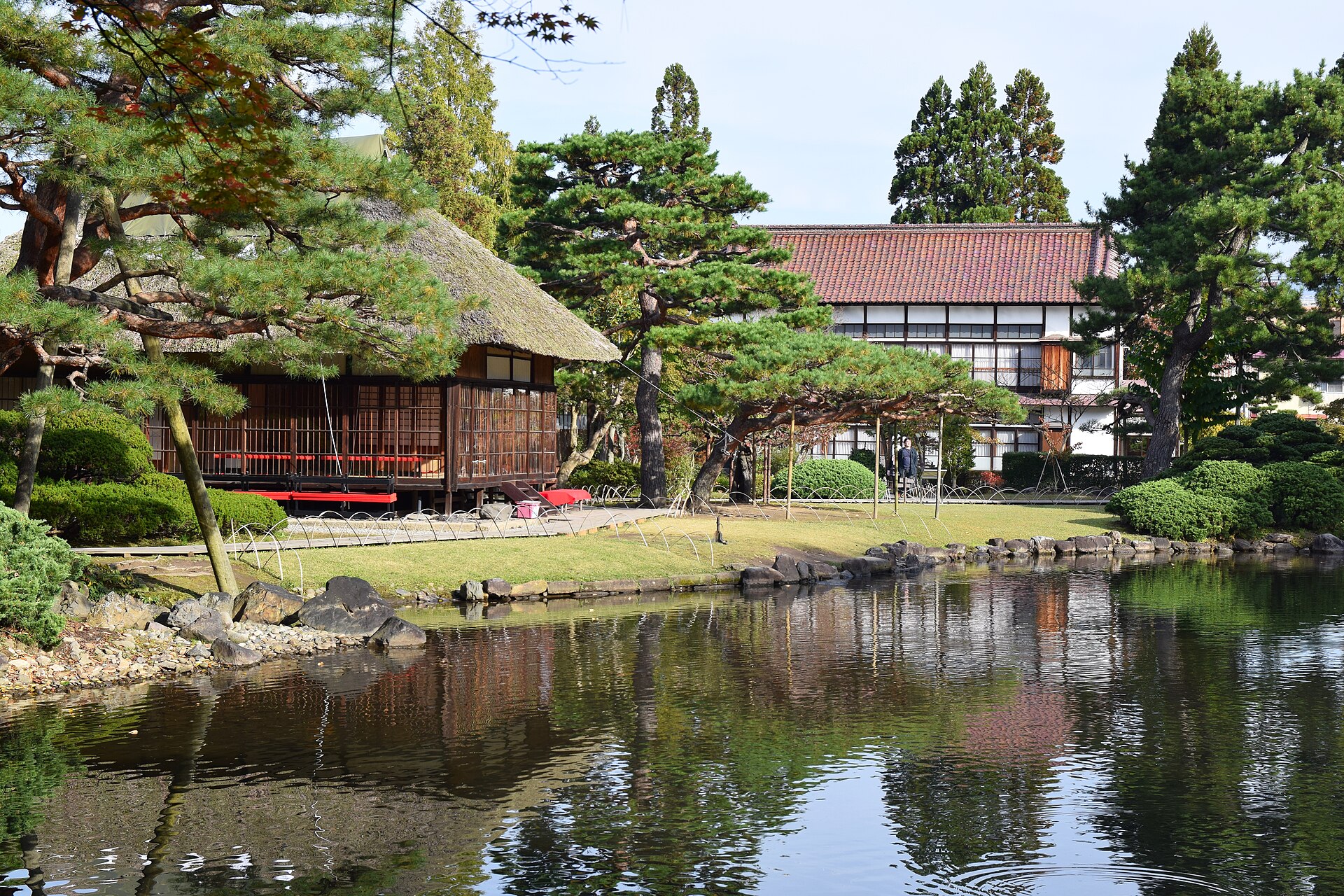
Oyaku-en is a garden of the Aizu Matsudaira clan located in Hanaharu-cho, Aizu-Wakamatsu City, and has been designated as a National Scenic Spot. Its official name is “Nationally Designated Scenic Spot: Aizu Matsudaira Clan Garden.”It is a rare garden in Japan that serves a dual purpose: it is both a strolling pond-style daimyo garden and a center for cultivating medicinal herbs—the very origin of its name. In this article, we’ll introduce the history, highlights, and admission information for Oyakuen based on official sources.
What Is the Oyakuen? | The Dual Roles of a Daimyo Garden and a Medicinal Herb Garden
Oyakuen is a garden with a circumference of approximately 540 meters and an area of about 1.7 hectares (approximately 5,100 tsubo).It is a strolling pond-and-spring garden that incorporates the mountain ranges of Mount Bandai and Higashiyama as borrowed scenery. It was designated a National Scenic Spot in 1932 (Showa 7) and has been open to the public since 1953 (Showa 28).
A major feature of the garden is that it served as a center for the cultivation and research of medicinal herbs for the feudal domain during the Edo period. A medicinal plant specimen garden still exists within the grounds, preserving the appearance of the garden’s former medicinal herb garden. It is a place where visitors can experience both the beauty of the garden and the history of medicinal herbs.
History | From a Summer Villa to the “Imperial Medicinal Garden”
The origins of the Oyakuen date back to the Muromachi period. It is said that around 1432 (Eikyō 4), Morihisa Ashina, the 10th lord of Aizu, built a villa on this site, and the Oyakuen is believed to have been established when Morishige, the 16th lord, restored that villa.Later, Hoshina Masayuki, the founder of the Aizu Matsudaira clan, landscaped the garden and began using it as a retreat.
A turning point came in 1670 (Kanbun 10). Masatsune Hoshina, the second feudal lord, established a medicinal herb garden within the grounds out of a desire to save his impoverished subjects from epidemics, and began experimenting with the cultivation of various medicinal herbs.During the reign of the third feudal lord, Matsudaira Masayasu, Korean ginseng (Otaneninjin) was trial-planted, and since its cultivation was widely encouraged among the general public, the garden came to be known as “the Lord’s Medicinal Garden” (Oyaku-en).
The garden’s current form is the result of a major renovation carried out in 1696 (the 9th year of the Genroku era) by Meguro Jōtei, a landscape architect in the tradition of Kobori Enshū, and Tatsuno Genzaemon, the construction commissioner. They expanded the scale of the garden and incorporated the “borrowed landscape” technique.
Korean ginseng subsequently became a monopoly operated directly by the domain, and a Ginseng Magistrate’s Office was established. Aizu-produced Korean ginseng was known as “Aizu Wa-ninjin,” and in 1830 (the first year of the Tenpō era), the first shipment of ginseng exported from Japan set sail from the port of Nagasaki bound for the Qing Dynasty (China).Toward the end of the Edo period, the garden was closely associated with the last feudal lord, Matsudaira Katamori; in 1883 (Meiji 16), Katamori’s family lived for several years at the Imperial Medicinal Garden, where their new residence had been built.
Highlights
The “Heart-Shaped Pond” and Rakujutei Pavilion
The “Heart-Shaped Pond” lies at the center of the garden. Water for the pond is drawn from two sources: Lake Inawashiro (via the Tonoguchi Weir) and the Yugawa River in Higashiyama. The island in the center of the pond is called Kamejima (Turtle Island), and atop it stands Rakujutei, a single-story, thatched-roof pavilion built in the sukiya-style.Rakujutei was a pavilion used by the feudal lord and senior domain officials for summer retreats and tea ceremonies; it was named by the third feudal lord, Matsudaira Masayasu. A garden path winds around the pond, allowing visitors to enjoy the changing scenery as they walk along this circular route.The pond’s banks are adorned with fir, cedar, and pine trees, as well as seasonal flowers and plants. Also located on the shore is Tsuruga-shimizu, a spring associated with a legend in which a crane is said to have alighted upon the healing waters.
Ochaya Palace
The Ochaya Palace, located on the west side of the pond, was used as a resting place for the feudal lord; it is said to have been built in 1696 (the 9th year of the Genroku era). It is a sukiya-style building featuring an upper room (Ue-no-ma), a middle room (Tsugi-no-ma), and an antechamber (Koto-no-ma), with a thatched roof.Traces of reused old timber—such as materials salvaged from dismantled farmhouses—can be seen in the structure, and legend has it that the feudal lord set an example of frugality for his subjects. During the Boshin War, the building was spared the ravages of war because it was used as a treatment center for wounded and sick soldiers of the Western Army; large sword marks, believed to date from that time, still remain on the pillars.From the Upper Room, one can enjoy a panoramic view of the garden, with the Rakujutei pavilion and the mountain range of Higashiyama stretching out as a borrowed landscape.
Medicinal Plant Specimen Garden
On the north side of the garden lies the Medicinal Plant Specimen Garden, established on the site of a medicinal herb cultivation area from the feudal era. The feudal lord’s vision lives on today, and visitors can view approximately 400 varieties of medicinal trees and herbs. This unique area offers insight into the origin of the garden’s name, “Oyaku-en” (Imperial Medicinal Garden).
Chōyōkaku
Chōyōkaku, located in the northwest corner of the garden, is a building associated with Her Imperial Highness Princess Setsuko of Chichibu.Originally built in 1928 (Showa 3) as an annex to a ryokan in Higashiyama Onsen to commemorate Her Imperial Highness Seitsuko’s engagement, it was relocated to the Medicinal Herb Garden in 1973 (Showa 48).Her Imperial Highness named it “Chōyōkaku” herself, in honor of the Chōyō Festival on September 9—her birthday.
Take a break at the matcha tea ceremony
Inside the garden, a matcha tea ceremony is available (600 yen per session, including matcha and sesame yokan). Operating hours are 9:30 a.m. to 4:00 p.m. (last order at 3:30 p.m.), and the service runs from mid-March through the end of November.Please note that the official website announces a price increase to 700 yen per seating starting December 1, 2026. The gift shop sells medicinal herb teas from the garden as well as its famous sesame yokan.
Admission Information & Access
- Opening Hours: 8:30 AM–5:00 PM (Last admission at 4:30 PM) *Since there is no lighting inside the garden, visitors are advised to arrive early during the winter months
- Closed: Open daily
- Admission Fees: Adults 330 yen, High School Students 270 yen, Elementary and Junior High School Students 160 yen (Groups of 30 or more: Adults 270 yen, High School Students 220 yen, Elementary and Junior High School Students 110 yen) *Free admission for the holder of a disability certificate
- Parking: 40 standard-sized vehicles (free)
- Address: 8-1 Hanaharu-cho, Aizuwakamatsu City, Fukushima Prefecture 965-0804
- Phone: 0242-27-2472
- Bus: Take the “Haikara-san” downtown loop bus from in front of Aizu-Wakamatsu Station for about 30 minutes; get off at “Oyaku-en” and the garden is right there. Alternatively, take the “Akabee” bus for about 15 minutes (or about 22 minutes depending on the route), get off at “Aizu-Wakamatsu Chamber of Commerce and Industry,” and walk 5 minutes
Information verified on: November 8, 2026 (Prices and hours are subject to change. Please check the Oyakuen official website for the latest information)
*Photo: “Oyakuen japanese garden (37598628050).jpg” (Photo by Raita Futo, CC BY 2.0, Wikimedia Commons)